Home / Workshop / Law · Lights
Law · Lights · · 8 min readBike lights in the UK: the law and what to actually buy
The legal minimum is older than most of the lights on the market. The common-sense minimum is quite a bit more.
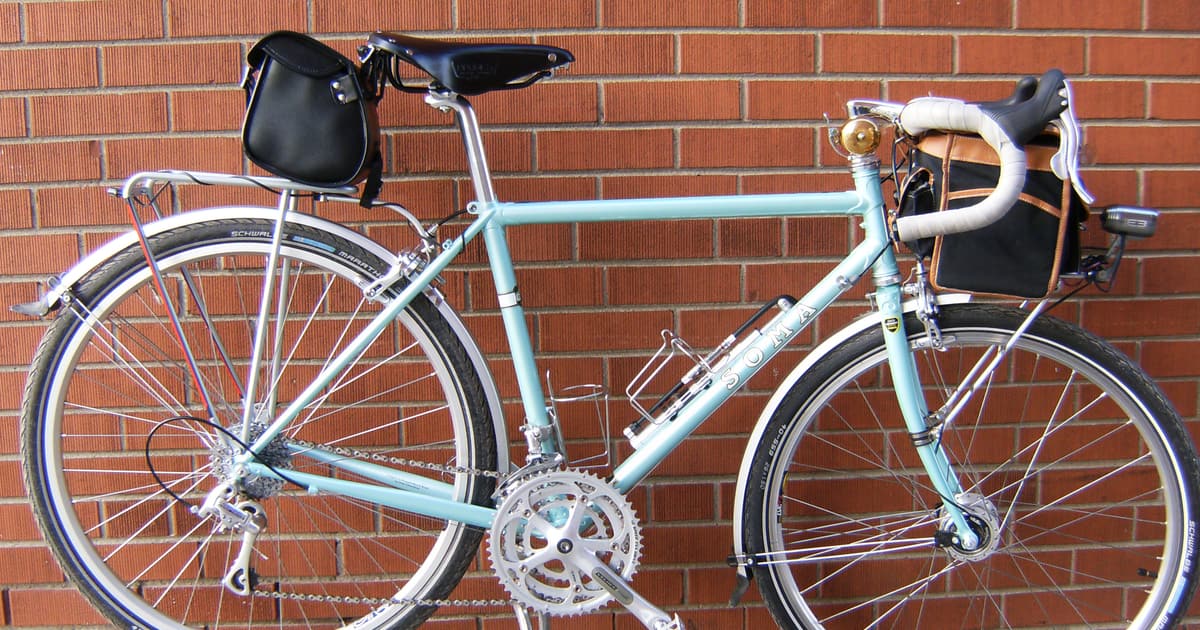
Photo: Bri.neary, CC BY-SA 3.0, via Wikimedia Commons.

This is one of those bits of bike ownership where the written rule and the sensible rule drift apart over time. The rule has not kept up with LEDs, cheap batteries, or the roads a modern commuter rides on in November. So here is both: what the law says, and what a workshop would actually tell you to run.
What the Highway Code says
The Highway Code, in its cyclist rules (59 to 82), is blunt: at night, your bike must have white front and red rear lights lit, and front and rear reflectors, plus pedal reflectors if the bike was built after 1985. "Night" here means the period between sunset and sunrise. The lights can be steady or flashing; if flashing, the regulations call for a flash rate between 60 and 240 per minute. A steady light that also flashes is fine for most people and most bikes.
That is the legal floor. It is a prosecutable offence to ride a pedal cycle on a public road in darkness without those lights and reflectors.
What that misses
The rule was drafted when "a bike light" meant a 2.4 watt incandescent bulb powered by a bottle dynamo. It is silent on lumens, beam shape, side visibility and, importantly, on what you do during the day. Modern town riding at dusk, through rain, under orange sodium, on a dark-painted bike with black panniers is not the problem the regulation was written for.
Front lights: beam shape matters more than lumen count
A "1,500 lumen MTB blaster" sold on a well-known marketplace will be bright. It will also throw a circular hotspot straight into oncoming traffic, cars and bikes alike, and spill most of its light into the trees. For urban use, look for a front light with a cut-off beam , a shaped pattern, usually labelled with a German StVZO type approval. The light sits at bar height, points slightly down, lights the road to about twenty metres in front, and does not dazzle anyone.
For a town commute at legal speed, anything from 40 to 100 lux with a cut-off is plenty. On country lanes without street lights, more is useful, but a shaped beam still beats a brighter round one.
Rear lights: steady and seen from the side
A single strobing rear light is legal but unkind. A faster flash, close to the upper end of the Code's range, is easier for drivers to read. A steady rear light with a gentle pulse is arguably the best compromise. If you ride in heavy traffic, a second rear light on a helmet or rucksack gives drivers a second point to judge your distance.
Side visibility is what the bare minimum misses most. A rear light that wraps around, or a small cheap light clipped to a seat-stay facing sideways, prevents the classic "appeared from nowhere" side-road collision.
Daytime running lights
There is good evidence from vehicle-safety research that a steady, visible light during the day reduces collisions, especially at junctions. A small, low-power flashing rear during the day costs little and is read by drivers as "cyclist present". Do not bother with a front light in sunlight; it simply drains the battery. In greyer light , the usual British afternoon in January , switch both on.
Dynamo lights: old-fashioned, still right
If your bike is a straight-line commuter and not raced at weekends, a hub dynamo and a pair of permanent lights is a lovely thing. It adds a few watts of resistance you will not feel, and the light is on every time you push off, forever. You never charge anything. A new build is not cheap; a used hub wheel and a decent pair of lights sometimes come up on Cycling UK's classifieds and local forums.
Reflectors , still legally required
Pedal reflectors are the awkward one, because clipless pedals usually have none. For legal night use the standard way is to use pedals that take a reflective sleeve or add reflective strips to the rear of your shoes or ankle straps. Many riders also fit spoke reflectors on the wheels , fine, visible, free with most bikes new.
Helmet and clothing
A helmet is not a legal requirement in the UK and a helmet light is not a substitute for a bike light. But a cheap rechargeable light on the back of the helmet, pointing slightly down and back, is bright at a driver's eye level and swings with where you are looking. That is useful at junctions. Hi-viz is an ongoing argument and not one we are going to settle in a bike-lights piece.
Common mistakes
- Front light aimed at the stars. Point it at the road about 10 to 15 metres ahead. Blinding drivers does not make you safer.
- Rear light buried in a rucksack mesh pocket. It is zero use when you cannot see it.
- Loose silicone bracket. They slip. Check your bracket is tight once a month.
- One USB cable for everything. Two lights that share a cable are two lights you did not charge.
Buying second-hand
We do not name brands as "best" here, but second-hand lights are a reasonable buy if you can inspect the lens (no cracks), the mount (not brittle), and the on-off switch (clicks properly). Old batteries in sealed lights lose capacity; a light that lasted eight hours new may do an hour at five years old. Price accordingly.
In short
Buy a front light with a shaped beam, a rear that flashes at the top end of the legal range plus a smaller steady for the side, keep spare batteries or a charger in your bag, and plug them in on Sunday. That is the law and a bit beyond , which is where any sensible rider lives.
If your brakes and chain are not up to the same standard, our pieces on brake adjustment and chain wear cover the rest of the basics.
The light that works is the one you actually charged this week.
Safety: any light is a help, not a shield. Ride defensively at junctions; the light does not beat the Highway Code, see-and-be-seen does.
About these pieces. Cranky Bikes is written by the editors and is not affiliated with any other site of a similar name. We do not sell bikes. We do not accept payment for links or coverage. If you spot something wrong, write to [email protected].