Home / Workshop / Security · Theft
Security · Theft · · 7 min readRegistering your bike against theft: the half-hour that pays off
The police recover more bikes than you think. They just cannot return the ones that nobody can prove belong to anybody.
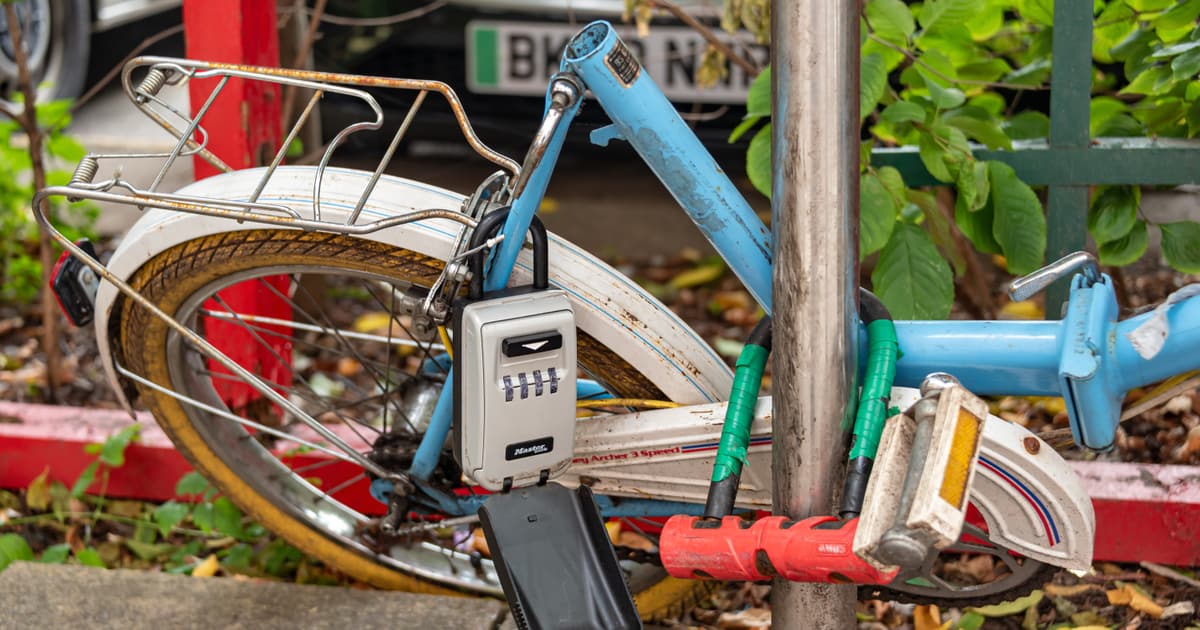
Photo: Jorge Franganillo, CC BY 4.0, via Wikimedia Commons.

Bike theft is a quiet grief. It happens in a minute. The lock lies cut on the pavement, you stand there for a moment thinking somebody has moved the bike as a joke, and then you walk home. We cannot stop that minute. But you can dramatically improve the odds of getting the bike back by doing half an hour of paperwork before it ever happens.
Why registration matters
Police forces across the UK recover stolen bikes regularly: at a raid, at a known fence, at a market, from a flat. The problem is not finding them. The problem is proving that a particular bike belongs to a particular person. A bike with no serial record and no photo of the owner with it is unclaimable property that ends up auctioned.
A registered bike with a frame number, photographs and ideally a security mark is a bike that can be returned. BikeRegister is the national cycle database used by UK police forces; registrations are free and stay on the database.
Step 1 , Find the frame number
Every bike built in the last couple of decades has a serial number stamped on the frame. It is almost always on the underside of the bottom bracket shell (the bit where the pedal cranks go through). Turn the bike upside down, wipe the shell clean, and copy the number exactly. Do not mistake the ISO size numbers for a serial. Serials are usually 7 to 14 digits or letters.
No serial? Rare, but it happens on older or custom frames. Make a careful note of any unique features , a repair weld, a scratch, a logo that is slightly off centre.
Step 2 , Photograph the bike
Three photographs are enough:
- A full side-on shot of the whole bike in good light.
- A close-up of the drive side (gears, chain, cranks).
- A close-up of the frame number, readable.
Keep the photos somewhere you can reach them from a phone that is not with the bike. Email them to yourself. Dropbox. Anything that lives in the cloud.
Step 3 , Register on BikeRegister
Create a free account, add the bike with its serial, a short description, and upload the photos. That is the whole registration. Do it on every bike you own, including the children's bikes; stolen kids' bikes are recovered at a surprising rate because they are not resold as easily and often turn up locally.
Some forces also run local schemes and periodic "mark and register" days where officers will apply a security mark to your bike at no cost. BikeRegister themselves also sell marking kits , tamper-evident labels and a chemical etching stencil that encodes your account reference into the frame. Not every bike needs marking, but a high-value bike probably does.
Step 4 , Insurance details
Separately from the police database, check your home contents insurance. Many policies cover bikes to a modest value as standard; higher-value bikes often need to be named on the policy, with a frame number and a purchase value. A quick email to the insurer, with the photos attached, closes the loop before you need it.
Step 5 , Lock the right bits of the bike to the right bits of the world
A frame locked to a Sheffield stand with the front wheel quick-release still on it is a frame. A rear wheel locked to a stand with no frame is a rear wheel. Lock the frame first, through the rear triangle; add a second lock to the front wheel if it is on a quick-release. If the saddle is on a quick-release too, swap that out for a bolt , a saddle and seatpost disappears from a station car park in seconds.
If the worst happens
Report the theft to the police within 24 hours. You will need a crime reference number for insurance. Give the serial, send the photos, say where and when. Then update the BikeRegister entry to "stolen"; the moment a police officer scans that serial it is flagged. Post on local Facebook groups and on the cycling community boards for your area; recovered bikes often come from an eagle-eyed neighbour who saw a stranger bringing a bike into a stairwell.
Check online marketplaces for the next fortnight. Stolen bikes tend to appear within a few days, usually with awful photographs and a vague story. Do not go to collect one yourself; pass the listing with the serial to the police.
What the half-hour actually costs you
Zero pounds for registration, your tea break for photographs, perhaps a tenner for a marking kit, perhaps thirty for a half-decent extra lock. Set against the cost of a replacement bike and the horror of losing a thing you ride every day, it is the most obviously worthwhile hour you can spend on bike admin.
If you want to think about the rest of the commute while you are at it, see our pieces on panniers, lights and brakes.
A registered, photographed bike is a bike the police can give back. Nothing else gets them past that hurdle.
Note: specific insurance limits, local police schemes and marking kit prices change. Check the current figures with your insurer and at BikeRegister before relying on numbers quoted anywhere, including here.
About these pieces. Cranky Bikes is written by the editors and is not affiliated with any other site of a similar name. We do not sell bikes. We do not accept payment for links or coverage. If you spot something wrong, write to [email protected].